
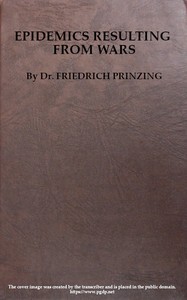
Epidemics Resulting from Wars by Friedrich Prinzing
Friedrich Prinzing's book isn't a story with characters in the traditional sense. Instead, the main character is a pattern—a brutal, repeating cycle throughout history. The plot is the relentless spread of disease in the wake of armies. Prinzing, a German physician and statistician, tracks this pattern from ancient times up to the wars of his own era, including the early years of World War I. He shows how typhus, cholera, and plague didn't just happen to be present during wars; they were directly fueled by the chaos, the mass movements of people, the breakdown of sanitation, and the malnutrition that conflict creates. The 'story' is the evidence he piles up, case by case, war by war, proving that disease has often been a bigger killer than the sword or the gun.
Why You Should Read It
You should read it because it makes the past feel uncomfortably relevant. Prinzing was writing over a century ago, but his core message—that public health collapses are a direct and devastating consequence of war—echoes in today's headlines from conflict zones. It's a sobering reminder that the casualties of war are counted long after the fighting stops. While the writing is academic, the sheer weight of the historical examples he provides is powerful. It forces you to see history through a different lens, one focused on suffering that often gets left out of the grand narratives of kings and battles.
Final Verdict
This is a book for the intellectually curious reader who loves history, science, or sociology. It's perfect for anyone who enjoyed books like Guns, Germs, and Steel and wants to explore a specific, grim chapter of that idea. It's not a light read—it's dense with data and detail—but it’s incredibly rewarding. If you're a history buff looking to understand the full human cost of war, or just someone fascinated by how interconnected our world has always been, Prinzing's work is a foundational and eye-opening text.
This work has been identified as being free of known copyright restrictions. Share knowledge freely with the world.
Margaret Davis
4 months agoGreat value and very well written.
Christopher Gonzalez
1 year agoMy first impression was quite positive because the clarity of the writing makes even the most dense sections readable. Finally, a source that prioritizes accuracy over hype.
Joseph Johnson
2 years agoWhile browsing through various academic sources, the breakdown of complex theories into digestible segments is masterfully done. Simple, effective, and authoritative – what else could you ask for?
Joseph Anderson
7 months agoBefore I started my latest project, I read this and the wealth of information provided exceeds the average market standard. This is a solid reference for both beginners and experts.







Jessica Smith
7 months agoGiven the current trends in this field, the cross-referencing of different chapters makes it a great study tool. Simple, effective, and authoritative – what else could you ask for?