About 24 minutes
Le Corbeau = The Raven — A Closer Reading
Fantasy Juvenile Worlds
5,426 recorded words. 3 minutes difference from this book's estimate.
View Gutenberg source #14082
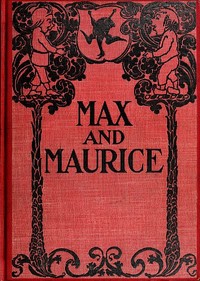
Before opening Max and Maurice: A Juvenile History in Seven Tricks — Reading Companion, the edition data offers a quick orientation: 6,200 words, 27 min estimated reading time, and 2 detected text sections.
The text analysis averages about 15.8 words per sentence, while the detected sections provide another way to judge how the source is divided.
Project Gutenberg metadata also associates the work with “Wit and humor,” connecting these edition facts with the source record’s subject description.
Explore this collection
These alternatives are selected using recorded categories and estimated reading time.
About 24 minutes
Fantasy Juvenile Worlds
5,426 recorded words. 3 minutes difference from this book's estimate.
View Gutenberg source #14082About 33 minutes
Fantasy Juvenile Worlds
7,584 recorded words. 6 minutes difference from this book's estimate.
View Gutenberg source #13648About 37 minutes
Fantasy Juvenile Worlds
8,289 recorded words. 10 minutes difference from this book's estimate.
View Gutenberg source #35996Search stored excerpts and compare books → Choose by your preferences →
Choices use stored catalog measurements. Estimates vary with reading speed. A shared category is a catalog label, not a claim that two books have the same argument or literary quality.
Search reads excerpt text stored with this catalog and links to its associated Gutenberg record. The connection is stored in the site database; this tool does not recheck that every excerpt is word-for-word identical to that external record. Excerpt search does not cover every chapter and does not verify historical publication dates.
Catalog snapshot checked: 2026-09-25. Coverage: 93 public books, 93 available source excerpts.
Read the complete public-domain text at its original source.
Read on Project GutenbergWilhelm Busch's Max and Maurice unfolds as a sequence of seven discrete tricks, each a self-contained episode that escalates in scale and consequence. The poem's structure is rigidly symmetrical: a trick is conceived, executed, and punished within a few stanzas, with the boys' victims—a widow, a tailor, a teacher, and others—reacting in predictable distress. This repetitive pattern gives the work the feel of a grim nursery rhyme, where each stanza builds toward a catastrophic punchline.
The translator, Charles T. Brooks, preserves Busch's original meter and rhyme scheme, lending the English version a singsong cadence that contrasts sharply with the violence of the content. The preface sets the moralizing tone, warning that the boys' mischief leads to a 'sad and dreary' end, but the verses themselves revel in the mechanics of each prank, from slicing bread to stringing up chickens.
The poem's subtitle, 'A Juvenile History in Seven Tricks,' announces its formal architecture. Each trick occupies a distinct chapter, and the narrative moves through them in a linear, cumulative fashion. The first trick—killing Widow Tibbets' chickens by tying bread to strings—establishes the pattern: the boys observe a domestic scene, devise a trap, execute it with precision, and witness the grotesque result. The chickens 'dangling' and 'strangling' on a tree introduce a recurring image of hanging that reappears in later episodes.
Subsequent tricks target a tailor, a teacher, and a farmer, among others. The structure allows no deviation: the boys never learn from their actions, and each trick is more elaborate than the last. The final trick, which involves the boys being baked into bread by a baker, mirrors the first trick's use of food as a weapon, creating a circular logic that underscores the poem's grim symmetry.
Three images recur across the tricks: hanging, food, and the disruption of domestic order. The first trick ends with chickens 'dangling' from a tree, their necks 'long and longer.' Later, the teacher is caught in a trap that leaves him suspended, and the boys themselves are ultimately ground into bread. Food appears as both bait and weapon: bread is sliced and tied to strings, apples are stolen, and the baker's oven becomes a tool of retribution.
Domestic settings—a widow's yard, a tailor's shop, a schoolroom—are invaded and transformed into sites of chaos. The poem dwells on the aftermath: Widow Tibbets weeps over her dead chickens, the tailor's house is destroyed, and the teacher is humiliated. These recurring elements create a cohesive visual and thematic vocabulary, reinforcing the idea that the boys' mischief is a perversion of everyday life.
The poem's movement between scenes is abrupt and episodic, with little transition. Each trick begins with a brief setup—often a single stanza describing the victim's routine—before the boys intervene. The action is compressed into a few vivid images: the slicing of bread, the tying of strings, the flight of chickens. The narrator shifts focus rapidly from the boys' planning to the victims' reactions, creating a rhythm of anticipation and payoff.
This swift movement mirrors the boys' own restlessness. They are never still; they 'take a view' and 'fell to thinking' before springing into action. The poem's pace accelerates as the tricks grow more violent, culminating in the final scene where the boys are baked into bread. The lack of reflection or moral commentary within the episodes leaves the reader to infer the consequences from the stark imagery alone.
The preface establishes a moral frame: the narrator addresses the reader directly, warning that the boys' story is a cautionary tale. The opening lines—'Ah, how oft we read or hear / Of boys we almost stand in fear of!'—set a tone of mock horror that persists throughout. The narrator interjects with exclamations like 'O dear, O dear, O deary' and 'Jiminee, O Jimini!' which undercut the violence with a playful, almost theatrical quality.
This dual voice—simultaneously moralizing and gleeful—creates a tension that defines the poem. The narrator condemns the boys' actions but lingers on the details of their tricks, describing the 'agony of strangling' with evident relish. The final stanza, which reports the boys' demise, is delivered without commentary, leaving the moral to the reader. This ambiguity is central to the work's enduring appeal: it can be read as a stern lesson or a dark comedy, depending on the reader's perspective.
Readers approaching Max and Maurice should attend to the interplay between its rigid structure and its chaotic content. The poem's seven tricks are not merely a sequence of pranks but a carefully constructed pattern of cause and effect, where each image—bread, string, hanging—echoes across episodes. The translation by Charles T. Brooks captures the original's rhythmic drive, making the violence feel both inevitable and absurd. This is a work that rewards attention to its formal precision, even as it revels in its own grotesque humor.
Those Busch boys, with their terrible, tidy little schemes—each jingle snapping shut like a trap. Reading them again, I find myself thinking of the long, thoughtful conversations in the Imaginary Conversations and Poems: A Selection — Text and Context, a world of measured voices. Both books share a quiet faith in the discipline of form, trusting the shape of a story to hold its meaning, whether that meaning is a laugh or a sigh.
Your answers remain private and are stored only in this browser.