About 64 minutes
L'Allegro, Il Penseroso, Comus, and Lycidas — Reading Companion
Fantasy Juvenile Worlds
14,513 recorded words. 1 minutes difference from this book's estimate.
View Gutenberg source #397
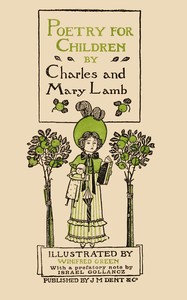
The source record for Poetry for children — Reading Companion measures this digital text at 14,876 words, 1 hr 5 min estimated reading time, and 41 detected text sections.
The text analysis averages about 27.4 words per sentence, while the detected sections provide another way to judge how the source is divided.
Project Gutenberg metadata also associates the work with “Children's poetry, English,” connecting these edition facts with the source record’s subject description.
Explore this collection
These alternatives are selected using recorded categories and estimated reading time.
About 64 minutes
Fantasy Juvenile Worlds
14,513 recorded words. 1 minutes difference from this book's estimate.
View Gutenberg source #397About 70 minutes
Fantasy Juvenile Worlds
15,949 recorded words. 5 minutes difference from this book's estimate.
View Gutenberg source #12389About 57 minutes
Fantasy Juvenile Worlds
12,976 recorded words. 8 minutes difference from this book's estimate.
View Gutenberg source #14757Search stored excerpts and compare books → Choose by your preferences →
Choices use stored catalog measurements. Estimates vary with reading speed. A shared category is a catalog label, not a claim that two books have the same argument or literary quality.
Search reads excerpt text stored with this catalog and links to its associated Gutenberg record. The connection is stored in the site database; this tool does not recheck that every excerpt is word-for-word identical to that external record. Excerpt search does not cover every chapter and does not verify historical publication dates.
Catalog snapshot checked: 2026-09-25. Coverage: 93 public books, 93 available source excerpts.
Read the complete public-domain text at its original source.
Read on Project GutenbergThe volume opens with Israel Gollancz's prefatory note, which immediately establishes a historical and sentimental frame: a reverie sparked by the sight of a Blue-coat boy in London. Gollancz imagines a conversation between two schoolboys, one a stammering younger lad with 'crisply curling black hair' and the other a learned 'Grecian,' evoking the boyhood of Charles Lamb and Samuel Taylor Coleridge. This framing device—part memoir, part fancy—sets an expectant, nostalgic tone that primes readers to approach the poems as artifacts of a bygone era rather than mere moral lessons.
The transition from Gollancz's prose to the Lambs' poetry is abrupt. The first poem, 'Memory,' introduces a personified female figure who declares, 'Gold purchases in me no share, / Nor do I dwell in distant land.' The poem's moral—that memory is won through 'study, and thought, and watchful care'—is delivered in a direct, instructive voice. This contrasts sharply with the prefatory note's wistful, descriptive style. Readers new to the collection may note how the Lambs favor clear, rhymed couplets and quatrains that spell out their lessons explicitly, leaving little room for ambiguity. The poem's speaker addresses a 'young forgetful Adelaide,' a fictional child whose fault is corrected by Memory's visit. This pattern of naming a child character and then resolving a flaw recurs throughout the book, as seen later in 'The Peach' and 'The Magpie's Nest.'
Later in the collection, 'Salome' retells the story of John the Baptist's beheading in a ballad-like form. The poem describes Salome's dance with 'grace peculiar' and Herod's rash oath, but its most striking feature is the final stanza, which shifts from narrative to commentary: 'When painters would by art express / Beauty in unloveliness, / Thee, Herodias’ daughter, thee, / They fittest subject take to be.' The Lambs here introduce a meta-artistic reflection on how Salome's beauty is rendered in painting—'a steadfast cruel gaze, / An eye unpitying.' This is a sophisticated move for a children's book, asking readers to consider the gap between outward grace and inner cruelty. The poem does not soften the violence; it names 'the ruthless deed' and the 'sullen joy' of the dancer. Compared to the domestic moralizing of earlier poems, this piece demands a more mature engagement with moral ambiguity.
'The Peach' offers a counterpoint to the biblical drama. Here, a mother divides a single peach among seven children, and the poem dwells on the emotional response: 'The tear was in our parent’s eye, / It seem’d quite out of season.' The mother explains that her tears are 'joy, and not dejection,' because the shared scarcity reminds her of mothers who have only 'a morsel of the coarsest fare.' The poem turns a simple domestic event into a lesson in gratitude and empathy. The Lambs use a first-person plural narrator ('Mamma gave us a single peach, / She shared it among seven') to create a sense of collective experience. This technique appears in several poems, inviting young readers to see themselves as part of a group of siblings learning together. The poem's structure—a small incident followed by a reflective explanation—mirrors the pattern of 'Memory' and reinforces the book's pedagogical aim.
'The Magpie’s Nest, A Fable' returns to a lighter, explanatory mode. It begins with a mythological origin story: 'When the Arts in their infancy were, / In a fable of old ’tis express’d / A wise magpie constructed that rare / Little house for young birds, call’d a nest.' The poem anthropomorphizes birds who seek the magpie's instruction, and the fragment suggests a lesson about skill and imitation. The fable form allows the Lambs to embed a moral about craftsmanship and learning without direct admonition. The poem's playful tone—'This was talk’d of the whole country round; / You might hear it on every bough sung'—contrasts with the solemnity of 'Salome' and the sentiment of 'The Peach.' This variety in register across the collection means that a first reader encounters different modes of address: the direct moral, the narrative reflection, and the allegorical tale. Each poem demands a slightly different kind of attention, from decoding a lesson to appreciating a story's symbolic weight.
Reading the Lambs' collection sequentially reveals a deliberate alternation between the homely and the exalted, the simple and the complex. The prefatory note's historical reverie may initially seem separate from the poems, but it establishes a tone of affectionate retrospection that colors the reader's approach. As you move through the book, pay attention to how each poem positions its child audience: sometimes as a pupil to be corrected, sometimes as a witness to a larger story. The shifts in voice—from the intimate 'we' of 'The Peach' to the detached narrator of 'Salome'—offer a subtle education in literary perspective.
In the Lamb collection, I've often lingered over how a ballad’s sorrow softens into a lullaby’s calm, a gentle schooling in life’s turns. That same steady pulse beats within English and Scottish Ballads, Volume VI — Background and Themes, where the old voices seem to whisper across the centuries, remembering what we once taught the young.
Your answers remain private and are stored only in this browser.