About 191 minutes
Prison Poetry — Inside the Classic
Fantasy Juvenile Worlds
43,783 recorded words. 3 minutes difference from this book's estimate.
View Gutenberg source #45674
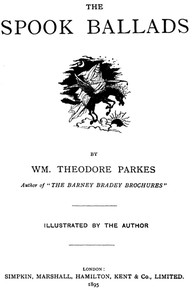
Before opening The Spook Ballads — Themes and Context, the edition data offers a quick orientation: 43,137 words, 3 hr 8 min estimated reading time, and 10 detected text sections.
The text analysis averages about 24.1 words per sentence, while the detected sections provide another way to judge how the source is divided.
Project Gutenberg metadata also associates the work with “Ghosts -- Poetry,” connecting these edition facts with the source record’s subject description.
Explore this collection
These alternatives are selected using recorded categories and estimated reading time.
About 191 minutes
Fantasy Juvenile Worlds
43,783 recorded words. 3 minutes difference from this book's estimate.
View Gutenberg source #45674About 220 minutes
Fantasy Juvenile Worlds
50,380 recorded words. 32 minutes difference from this book's estimate.
View Gutenberg source #5419About 221 minutes
Fantasy Juvenile Worlds
50,697 recorded words. 33 minutes difference from this book's estimate.
View Gutenberg source #8497Search stored excerpts and compare books → Choose by your preferences →
Choices use stored catalog measurements. Estimates vary with reading speed. A shared category is a catalog label, not a claim that two books have the same argument or literary quality.
Search reads excerpt text stored with this catalog and links to its associated Gutenberg record. The connection is stored in the site database; this tool does not recheck that every excerpt is word-for-word identical to that external record. Excerpt search does not cover every chapter and does not verify historical publication dates.
Catalog snapshot checked: 2026-09-25. Coverage: 93 public books, 93 available source excerpts.
Read the complete public-domain text at its original source.
Read on Project GutenbergParkes opens The Spook Ballads with a press section that compares him to Ingoldsby, Thomas Hood, and W. S. Gilbert, but the poems themselves reveal a distinct voice: one that leans into Irish dialect, absurd physical comedy, and a narrator who often sounds as flustered as his characters. In 'The Girl of Castlebar,' the duel between Kit O'Gorman and Pat O'Byrne is repeatedly interrupted by their donkeys, who 'capered round, and fought' while the men struggle to land a blow. The poem's pace shifts from mock-heroic description to rapid-fire dialogue, as when O'Byrne complains, 'Four mortial hours we've struggled—an' I'm all in a sweat!'
Parkes uses Irish dialect not as mere decoration but as a rhythmic device. In 'The Girl of Castlebar,' exclamations like 'Bad scran to it!' and 'O tear o'war' punctuate the narrative, slowing or accelerating the meter. The narrator's own voice shifts between formal stanza structures and colloquial asides, as when he notes 'We sought a Pub, and pondered, and drank, and sadly swore.' This blending of registers creates a conversational tone that undercuts the ballad's traditional solemnity.
The dialect also serves character differentiation: O'Gorman and O'Byrne speak in thicker brogue than the narrator, while the servant's sneering 'She's gone off to be married' is delivered in standard English. Such choices hint at class and education without explicit commentary.
The duel in 'The Girl of Castlebar' is a masterclass in comic pacing. Parkes stretches the fight over hours—'six o'clock commencing, and now, the strokes of ten'—while the donkeys repeatedly interrupt the action. The poem's rhythm mirrors the farce: long, winding lines describing the clash are suddenly broken by short exclamations or parenthetical asides. For instance, after the men are thrown, the narrative pauses for 'The assmen, quickly bounded unto their feet again' before resuming the chase.
This technique appears elsewhere: in 'Tears-in-Law,' the speaker's question 'O is she dead, thy wife?' is undercut by the reply 'Ah woe! ... you think my wife / Is gone, alas! she's not.' The delayed punchline relies on a sudden shift in pace.
Parkes often employs a first-person narrator who is both participant and commentator, but whose reliability is questionable. In 'The Abdicated Crown,' the speaker admits 'Five bob is all I ask,' yet the poem ends with the debt unpaid—'That abdicated crown is debit yet!'—suggesting either forgetfulness or evasion. Similarly, in 'The Girl of Castlebar,' the narrator recounts the duel as if an eyewitness, but his knowledge of private notes and servant's remarks implies a constructed, rather than factual, account.
This narrative voice allows Parkes to shift tone abruptly: from mock-heroic to self-deprecating, from sentimental to bawdy. The reader is never quite sure whether to trust the teller, which keeps the ballads lively and unpredictable.
These ballads reward attention to their verbal play and structural quirks. Readers may find that the humor deepens on a second reading, as the interplay between dialect, meter, and narrative voice becomes more apparent. Parkes's illustrations, mentioned in the press notices, are absent from this text edition, but the poems themselves carry a visual energy through their vivid, often ridiculous, imagery.
There’s a particular ache in comedy that lingers, the way Parkes’s donkeys and duels somehow turn into echoes of the grave. I found that same restless sorrow rereading Le Corbeau = The Raven — A Closer Reading—one is footlights, the other candlelight, but both know the room goes quiet. Strange, how laughter and loss keep the same company.
Your answers remain private and are stored only in this browser.