About 251 minutes
English and Scottish Ballads, Volume VI — Background and Themes
Fantasy Juvenile Worlds
57,524 recorded words. 183 minutes difference from this book's estimate.
View Gutenberg source #39766
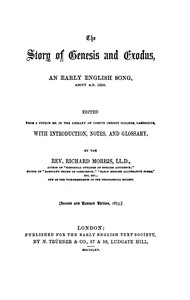
Before opening The Story of Genesis and Exodus: An Early English Song, about 1250 A.D. — Reading Companion, the edition data offers a quick orientation: 99,613 words, 7 hr 14 min estimated reading time, and 46 detected text sections.
The text analysis averages about 9.4 words per sentence, while the detected sections provide another way to judge how the source is divided.
Project Gutenberg metadata also associates the work with “Christian poetry, English (Middle),” connecting these edition facts with the source record’s subject description.
Explore this collection
These alternatives are selected using recorded categories and estimated reading time.
About 251 minutes
Fantasy Juvenile Worlds
57,524 recorded words. 183 minutes difference from this book's estimate.
View Gutenberg source #39766About 623 minutes
Fantasy Juvenile Worlds
143,168 recorded words. 189 minutes difference from this book's estimate.
View Gutenberg source #21628About 241 minutes
Fantasy Juvenile Worlds
55,241 recorded words. 193 minutes difference from this book's estimate.
View Gutenberg source #65068Search stored excerpts and compare books → Choose by your preferences →
Choices use stored catalog measurements. Estimates vary with reading speed. A shared category is a catalog label, not a claim that two books have the same argument or literary quality.
Search reads excerpt text stored with this catalog and links to its associated Gutenberg record. The connection is stored in the site database; this tool does not recheck that every excerpt is word-for-word identical to that external record. Excerpt search does not cover every chapter and does not verify historical publication dates.
Catalog snapshot checked: 2026-09-25. Coverage: 93 public books, 93 available source excerpts.
Read the complete public-domain text at its original source.
Read on Project GutenbergThis edition presents a Middle English poem composed around 1250 A.D., preserved in a single manuscript at Corpus Christi College, Cambridge. The editor, Richard Morris, worked from a transcription by F. J. Furnivall and proofread by W. W. Skeat, never having seen the original vellum. The poem retells Genesis and Exodus in rhyming couplets, using a dialect that mixes East Midland and Southern features. Morris’s apparatus includes marginal analysis, conjectural readings, and a glossary that clarifies obsolete words like giscinge (covetousness) and kumeling (foreign ruler).
Morris’s preface candidly admits he never examined the manuscript himself. Instead, he relied on Furnivall’s copy and Skeat’s collation. This indirect method raises questions about textual authority, yet Morris insists that every doubtful passage was checked against the original. The manuscript itself is described as a small vellum volume (8 × 4½ inches) with eighty-one leaves, written in a clear hand around 1300. Initial letters are marked with red dabs, and the text uses long final s’s. Such physical details ground the poem in a specific material culture, even as the editor works at a remove.
The glossary and footnotes reveal words that have since vanished or shifted meaning. For instance, fendes fleiðing (devil’s flaying) appears in Shoreham’s poems; arsmetike is a form of arithmetic; vn-achteled means unestimated or immense. The note on wol wel compares it to Old High German vil wol (very well). These annotations do more than define—they trace cognates across Germanic languages and cite parallel texts like Layamon’s Brut and the Owl and Nightingale. Readers interested in historical linguistics will find a rich vein of comparative evidence.
The poem condenses two biblical books into roughly 4,000 lines of verse. Morris’s marginal analysis breaks the story into episodes, but the excerpts show how the poet handles transitions. For example, the line Thare let hur, and ðeðen he nam (Terah left Ur and thence he went) uses let for “left” and nam for “departed,” compressing action into a single couplet. The meter is irregular, often with internal rhyme or alliteration, as in hunger bond (famine). The poet also inserts moralizing comments, like giscinge of louerd-hed (greed of lordship), which reflect a homiletic purpose beyond mere translation.
Readers approaching this text should treat Morris’s edition as a scholarly reconstruction, not a facsimile. The glossary is essential for navigating the Middle English vocabulary, and the footnotes often clarify textual cruces. Because the poem survives in only one manuscript, every variant reading carries weight. Those interested in the development of English verse or medieval biblical adaptation will find this a rewarding primary source, best read alongside the biblical passages it paraphrases.
There’s something tender about a poem sung plainly, a story carried in rough meter—these old verses feel like a voice from a cold hall, still warm. It reminds me of the quiet joy in Milton’s pastoral scenes, where light moves slowly through woods. L'Allegro, Il Penseroso, Comus, and Lycidas — Reading Companion sits beside that same patient reverence for what words can hold.
Your answers remain private and are stored only in this browser.