About 25 minutes
Three Unpublished Poems — Themes and Context
Science Fiction Utopias
5,712 recorded words. 5 minutes difference from this book's estimate.
View Gutenberg source #28218
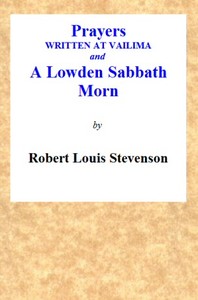
The catalog record for Prayers Written At Vailima, and A Lowden Sabbath Morn — A Reader’s Guide provides practical reading context through 6,891 words, 30 min estimated reading time, and 1 detected text section.
The text analysis averages about 25.2 words per sentence, while the detected sections provide another way to judge how the source is divided.
Project Gutenberg metadata also associates the work with “Stevenson, Robert Louis, 1850-1894 -- Travel -- Samoan Islands,” connecting these edition facts with the source record’s subject description.
Explore this collection
These alternatives are selected using recorded categories and estimated reading time.
About 25 minutes
Science Fiction Utopias
5,712 recorded words. 5 minutes difference from this book's estimate.
View Gutenberg source #28218About 17 minutes
Science Fiction Utopias
3,711 recorded words. 13 minutes difference from this book's estimate.
View Gutenberg source #23792About 53 minutes
Science Fiction Utopias
12,074 recorded words. 23 minutes difference from this book's estimate.
View Gutenberg source #42166Search stored excerpts and compare books → Choose by your preferences →
Choices use stored catalog measurements. Estimates vary with reading speed. A shared category is a catalog label, not a claim that two books have the same argument or literary quality.
Search reads excerpt text stored with this catalog and links to its associated Gutenberg record. The connection is stored in the site database; this tool does not recheck that every excerpt is word-for-word identical to that external record. Excerpt search does not cover every chapter and does not verify historical publication dates.
Catalog snapshot checked: 2026-09-25. Coverage: 93 public books, 93 available source excerpts.
Read the complete public-domain text at its original source.
Read on Project GutenbergThe two works bound here could hardly be more different in voice, yet each is a form of prayer. The first, Prayers Written at Vailima, consists of brief, earnest supplications composed by Robert Louis Stevenson for his Samoan household. The second, A Lowden Sabbath Morn, is a Scots-dialect poem that satirizes a Scottish kirk service. Fanny Van de Grift Stevenson’s introduction to the prayers explains their origin: the evening ‘pu’ or war conch summoned the family and retainers to worship, a practice that, she notes, ‘increased the influence of Tusitala tenfold.’ The poem, by contrast, opens with a boy ‘birlin’ at the door’ and builds a crowded, comic scene of rural piety. Together, they reveal Stevenson’s range—from the plain, reverent language of the prayers to the dense, phonetic Scots of the poem, where rhythm and rhyme drive the satire.
The prayers themselves are short, direct, and unadorned. They avoid elaborate metaphor or theological argument. One asks for ‘the spirit of obedience and the grace of humility’; another gives thanks for ‘the joy of the morning.’ The syntax is simple, the vocabulary plain. This spareness seems deliberate: the prayers were meant to be spoken aloud by a multilingual household. Fanny Stevenson’s introduction frames them as a practical necessity—‘the religious scruples of the natives’ had to be satisfied—but also as a genuine expression of Stevenson’s own need for ‘the direct appeal.’ The voice is that of a man speaking to God without rhetorical flourish, in a setting where the war conch could sound for peace. The contrast with the poem’s dense Scots could not be sharper.
A Lowden Sabbath Morn moves in swift, rhyming stanzas (ababcc) that mimic the bustle of a Sunday morning. The poem opens with a boy ‘birlin’ at the door’ and proceeds through the gathering congregation, the elders at the plate, the graves of kin, and the minister’s sermon. Stevenson’s ear for dialect is precise: ‘runkled breeks,’ ‘cleiks the sonsie misses,’ ‘yirks the tüne into the air / Wi’ queer contortions.’ The tone is affectionate but sharp. The minister ‘burkes the hopes o’ men that trust in works’ and ‘expounds the fau’ts o’ ither kirks.’ Yet the poem ends with a wry benediction: the ‘bonny creed’ lets the sleeper sleep and the dead ‘sleep aye the deeper.’ The rhythm never flags; the satire is carried by the bounce of the verse.
The shift from the prayers to the poem is a shift in tempo as much as in language. The Vailima prayers are slow, meditative, and repetitive—each one a short paragraph of petition or thanksgiving. They invite pause. The poem, by contrast, is rapid and accumulative. Its stanzas pile detail on detail: the boy, the guidman, the neebours, the bells, the elders, the graves. Where the prayers are still, the poem is kinetic. Even within the poem, pace varies: the opening stanzas hurry through the morning crowd; the middle stanzas slow at the kirkyard, where ‘the guidman sall bide awee / To dwall amang the deid’; then the sermon stanzas pick up speed again. This control of tempo is one of Stevenson’s chief devices, and it is on full display here.
Readers coming to this volume from Stevenson’s novels or essays will find a different side of his craft: the discipline of the short devotional form and the playfulness of dialect verse. The two works are best read side by side, noting how each handles the same subject—communal worship—through opposite means. The prayers ask for silence; the poem fills the air with noise. Together, they show a writer equally at home in the plain style and the vernacular, and equally attentive to the rhythms of spoken language.
Flipping through Prayers Written At Vailima, I paused at the Scots cadence of “A Lowden Sabbath Morn,” and felt that odd, distant kinship with an old hall’s echo. Both texts wrestle with community and its quiet ruptures. That reminded me of the Beowulf: An Anglo-Saxon Epic Poem — Key Ideas to Explore, whose mead-hall warmth holds a similar loneliness beneath the song.
Create a short personal record of your experience with this book.