About 25 minutes
Three Unpublished Poems — Themes and Context
Science Fiction Utopias
5,712 recorded words. 8 minutes difference from this book's estimate.
View Gutenberg source #28218
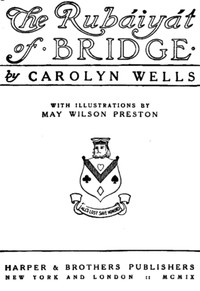
The source record for The Rubáiyát of Bridge — Text and Context measures this digital text at 3,711 words, 17 min estimated reading time, and 1 detected text section.
The text analysis averages about 23.6 words per sentence, while the detected sections provide another way to judge how the source is divided.
Project Gutenberg metadata also associates the work with “Omar Khayyam -- Parodies, imitations, etc.,” connecting these edition facts with the source record’s subject description.
Explore this collection
These alternatives are selected using recorded categories and estimated reading time.
About 25 minutes
Science Fiction Utopias
5,712 recorded words. 8 minutes difference from this book's estimate.
View Gutenberg source #28218About 30 minutes
Science Fiction Utopias
6,891 recorded words. 13 minutes difference from this book's estimate.
View Gutenberg source #616About 53 minutes
Science Fiction Utopias
12,074 recorded words. 36 minutes difference from this book's estimate.
View Gutenberg source #42166Search stored excerpts and compare books → Choose by your preferences →
Choices use stored catalog measurements. Estimates vary with reading speed. A shared category is a catalog label, not a claim that two books have the same argument or literary quality.
Search reads excerpt text stored with this catalog and links to its associated Gutenberg record. The connection is stored in the site database; this tool does not recheck that every excerpt is word-for-word identical to that external record. Excerpt search does not cover every chapter and does not verify historical publication dates.
Catalog snapshot checked: 2026-09-25. Coverage: 93 public books, 93 available source excerpts.
Read the complete public-domain text at its original source.
Read on Project GutenbergCarolyn Wells's The Rubáiyát of Bridge (1909) is a sustained parody that maps the quatrains of Omar Khayyám onto the rituals and frustrations of bridge whist. The opening stanza establishes the conceit: “Now the new Rubber rousing new Desires, / The Thoughtful Soul to Doubling Hearts aspires.” Wells replaces Khayyám’s philosophical wine and love with card-play specifics—rubber, doubling, dummy—while preserving the original’s AABA rhyme and meditative tone. The result is a double exposure: the reader sees both the Persian fatalist and the modern card player, each confronting a universe governed by chance.
Wells’s primary authorial choice is the systematic substitution of bridge terminology for Khayyám’s imagery. Where the original speaks of “the Wine” and “the Tavern,” Wells writes of “the Lead,” “the Discard,” and “the Odd Trick.” The parody gains its comic effect from the incongruity of high-flown quatrains about “the Red Hand of Dummy” or “the Heart Convention.” The diction is precise: “Finesse,” “No Trumps,” “Fourth Hand,” “Low Lead.” These are not generic card terms but specific bridge rules from the early twentieth century. Wells even references contemporary bridge authorities: “By Street and Elwell tamely to abide” alludes to the rulebooks of J. B. Elwell and the Street family. The vocabulary anchors the parody in a real, rule-bound game, making the humor accessible only to readers familiar with bridge.
The speaker’s voice shifts between the weary philosopher of Khayyám and the exasperated bridge player. Wells retains the original’s first-person reflections but fills them with card-specific complaints: “I sometimes think there's never such Tirade / As where some Bridge Game has been badly Played.” The voice is confessional and self-deprecating, as when the speaker recalls attending tournaments and hearing “Great Argument / About this Point and That” yet emerging “no Better Player than I went.” The parody’s emotional range—frustration, resignation, ironic hope—mirrors the original’s carpe diem urgency but transposes it to the card table. The repeated exclamation “He knows about it all! He Knows!! He Knows!!!” captures the voice of the kibitzer, a figure absent from Khayyám but central to bridge culture.
Wells adheres to the Rubáiyát’s stanza form: four lines, with the first, second, and fourth rhyming (AABA). Each quatrain functions like a miniature hand record, presenting a specific bridge situation or rule. For example: “With more than Three Hearts, always lead the Low!” is a direct rule, while “When the Red Hand of Dummy is laid down, / And even Hope of the Odd Trick expires!” describes a moment of defeat. The structure allows Wells to move between concrete instruction and comic despair. The parody does not tell a continuous story; instead, each stanza is a self-contained vignette, much like Khayyám’s meditations. This modular structure suits the subject: bridge is a series of discrete hands, each with its own drama.
Two motifs recur across the quatrains: the kibitzer and the score. The kibitzer appears in the stanza “But he who Stands Beside you, Looking On,— / He knows about it all! He Knows!! He Knows!!!” This figure—the onlooker who offers unsolicited advice—is a staple of bridge humor and is absent from Khayyám. The score is another recurring detail: “the Stubborn Score,” “the Gain of Penny Points,” “the Lovely Prizes.” Wells uses the score to anchor the parody in the material stakes of the game, contrasting with Khayyám’s abstract “Wine” and “Love.” The final quatrain in the excerpt advises: “Oh, take the Prize and let the Pennies go,” a direct echo of the original’s carpe diem but applied to tournament prizes. These details root the parody in the social and competitive reality of early 1900s bridge.
Readers unfamiliar with bridge may miss some technical references, but the parody’s core—the comic mismatch between high poetic form and mundane card play—remains accessible. Wells’s achievement lies in her fidelity to both source texts: the Rubáiyát’s meter and the bridge rulebook. The poem rewards those who know the game, but even a casual reader can enjoy the spectacle of Khayyám’s quatrains repurposed for the card table.
That rainy afternoon, the Rubáiyát of Bridge made me laugh at how neatly despair fits into a finesse. Later, the patter of cards faded into something quieter, a longing that felt less like a game and more like waiting. It reminded me of the tender ache in Last Poems: Translations from the Book of Indian Love — Reading Companion, which I picked up almost by accident, and somehow finished before the rain stopped.
Create a short personal record of your experience with this book.