About 28 minutes
The Rubaiyat of Omar Cayenne — Inside the Classic
Adventure Picaresque Fiction
6,338 recorded words. 2 minutes difference from this book's estimate.
View Gutenberg source #28184
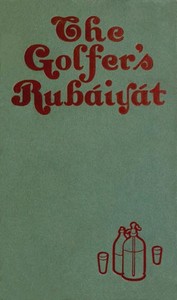
The source record for The Golfer's Rubaiyat — Context and Discussion measures this digital text at 5,814 words, 26 min estimated reading time, and 2 detected text sections.
The text analysis averages about 25.8 words per sentence, while the detected sections provide another way to judge how the source is divided.
Project Gutenberg metadata also associates the work with “Omar Khayyam -- Parodies, imitations, etc.,” connecting these edition facts with the source record’s subject description.
Explore this collection
These alternatives are selected using recorded categories and estimated reading time.
About 28 minutes
Adventure Picaresque Fiction
6,338 recorded words. 2 minutes difference from this book's estimate.
View Gutenberg source #28184About 17 minutes
Adventure Picaresque Fiction
3,778 recorded words. 9 minutes difference from this book's estimate.
View Gutenberg source #23338About 47 minutes
Adventure Picaresque Fiction
10,652 recorded words. 21 minutes difference from this book's estimate.
View Gutenberg source #6136Search stored excerpts and compare books → Choose by your preferences →
Choices use stored catalog measurements. Estimates vary with reading speed. A shared category is a catalog label, not a claim that two books have the same argument or literary quality.
Search reads excerpt text stored with this catalog and links to its associated Gutenberg record. The connection is stored in the site database; this tool does not recheck that every excerpt is word-for-word identical to that external record. Excerpt search does not cover every chapter and does not verify historical publication dates.
Catalog snapshot checked: 2026-09-25. Coverage: 93 public books, 93 available source excerpts.
Read the complete public-domain text at its original source.
Read on Project GutenbergHenry Walcott Boynton’s The Golfer’s Rubáiyát adapts the quatrain form of Omar Khayyám to the golf course, replacing wine and love with clubs, balls, and bunkers. The opening couplet—‘I WAKE! for the sun has driven in equal flight / The stars before him from the Tee of Night’—immediately establishes the conceit: celestial bodies become golf balls, and the sun wields a ‘gold-shod Shaft of Light.’ This playful transposition persists throughout, as Boynton maps Khayyám’s carpe diem onto the golfer’s urgency to play before the ‘Club of Time’ swings.
Boynton’s diction fuses golf terminology with Khayyám’s vocabulary. Terms like ‘Tee,’ ‘Green,’ ‘Bunker,’ ‘Handicap,’ and ‘Medal’ appear alongside ‘Cup of Life’ and ‘Destin’d Hour.’ The poem’s voice is deliberately archaic—‘Loiterer,’ ‘thou,’ ‘anew’—yet grounded in the specific language of the links. For instance, ‘the Cup of Life is ebbing Drop by Drop, / Whether the Cup be filled with Scotch or Bock’ (stanza VIII) puns on the golf trophy and the drink. This blend creates a tone that is both lofty and colloquial, inviting the reader to see golf as a serious, almost philosophical pursuit.
The poem adheres strictly to the Rubáiyát’s AABA rhyme scheme, with each quatrain a self-contained thought. Boynton uses this structure to deliver punchy observations: ‘A BAG of Clubs, a Silver-Town or two, / A Flask of Scotch, a Pipe of Shag—and Thou / Beside me caddying in the Wilderness— / Ah, Wilderness were Paradise enow’ (stanza XII). The enjambment across lines mimics the swing of a club, while the final line often delivers a twist—a wry comment on fame, mortality, or the futility of chasing championships. The repetition of ‘Fore!’ in stanza VI echoes the golfer’s warning cry, turning it into a lament.
Boynton’s setting spans both Scottish and American courses: ‘Musselburgh or Shinnecock’ (stanza VIII) and ‘St. Andrew’s Shrine’ (stanza VI). This geographic range grounds the parody in real places, while the ‘strip of sandy Down’ (stanza XI) evokes a generic seaside links. The poem’s temporal setting is equally specific—‘the first Summer month of opening Greens’ (stanza IX) and ‘the fire of Spring’ (stanza VII). These details anchor the metaphysical reflections in a recognizable golf calendar, making the carpe diem theme feel immediate to any golfer awaiting the season’s start.
Time is a constant presence: the sun ‘holed’ the stars, the ‘Club of Time’ swings, and ‘the Cup of Life is ebbing.’ Fame is dismissed as fleeting—‘Champion after Champion with his Pomp / Abode his destin’d Hour’ (stanza XVII). The match itself becomes a metaphor for life: ‘Ah, play the Match, and let the Medal go, / Nor heed old Bogey with his wretched Sum’ (stanza XIII). These motifs recur across quatrains, reinforcing the poem’s central argument: golf, like life, is best enjoyed in the moment, not in the pursuit of records or glory.
Boynton’s parody succeeds by taking its source seriously: the quatrains are not mere jokes but genuine meditations on mortality, leisure, and obsession. Readers familiar with Khayyám will appreciate the fidelity to form, while golfers will recognize the insider references. The poem rewards slow reading—each stanza offers a new angle on the game’s absurdities and profundities. Approach it as a companion to a round, not a manual.
Reading The Golfer's Rubaiyat, I kept smiling at how lightly it carries its own melancholy, all fairways and lost balls standing in for larger chances. It reminded me of an old volume I once leafed through, Yorkshire Ditties, Second Series To which is added The Cream of Wit and Humour from his Popular Writings — A Reader’s Guide, whose dialect jokes hide the same gentle ache. Both feel like laughing at twilight.
Capture what you thought, learned, and would like to remember.