About 26 minutes
The Golfer's Rubaiyat — Context and Discussion
Adventure Picaresque Fiction
5,814 recorded words. 2 minutes difference from this book's estimate.
View Gutenberg source #24018
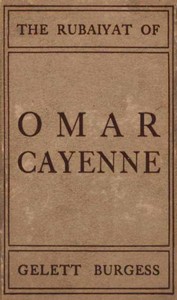
For The Rubaiyat of Omar Cayenne — Inside the Classic, the stored edition analysis reports 6,338 words, 28 min estimated reading time, and 1 detected text section.
The text analysis averages about 24.6 words per sentence, while the detected sections provide another way to judge how the source is divided.
Project Gutenberg metadata also associates the work with “Literature -- History and criticism,” connecting these edition facts with the source record’s subject description.
Explore this collection
These alternatives are selected using recorded categories and estimated reading time.
About 26 minutes
Adventure Picaresque Fiction
5,814 recorded words. 2 minutes difference from this book's estimate.
View Gutenberg source #24018About 17 minutes
Adventure Picaresque Fiction
3,778 recorded words. 11 minutes difference from this book's estimate.
View Gutenberg source #23338About 47 minutes
Adventure Picaresque Fiction
10,652 recorded words. 19 minutes difference from this book's estimate.
View Gutenberg source #6136Search stored excerpts and compare books → Choose by your preferences →
Choices use stored catalog measurements. Estimates vary with reading speed. A shared category is a catalog label, not a claim that two books have the same argument or literary quality.
Search reads excerpt text stored with this catalog and links to its associated Gutenberg record. The connection is stored in the site database; this tool does not recheck that every excerpt is word-for-word identical to that external record. Excerpt search does not cover every chapter and does not verify historical publication dates.
Catalog snapshot checked: 2026-09-25. Coverage: 93 public books, 93 available source excerpts.
Read the complete public-domain text at its original source.
Read on Project GutenbergGelett Burgess's The Rubaiyat of Omar Cayenne (1904) borrows the quatrain form of Edward FitzGerald's translation of Omar Khayyam to lampoon the early twentieth-century literary marketplace. The poem moves through a series of vignettes that track a manuscript's journey from author's desk to publisher's rejection, punctuated by broader swipes at bestsellers, reviewers, and the cult of first editions. Burgess's speaker adopts the voice of a disgruntled author who watches contemporaries rise and fall—Anthony Hope, Conan Doyle, and Mary MacLane are named—while his own work languishes. The structure follows the original Rubaiyat's numbered quatrains but replaces philosophical meditation with commercial complaint.
Burgess preserves the four-line stanza of the Rubaiyat but repurposes its rhyme scheme (AABA) for punchy, epigrammatic attacks. Each quatrain typically isolates a single target: the opening stanza imagines a "Hack" scattering Shakespeare and Dante, while later ones mock specific publishers (Century, Doubleday, Harpers) and newspapers (The New York Times, The Boston Transcript). The brevity of the form forces Burgess to compress his satire into a single image or ironic reversal—for example, the claim that tenth editions are rarer than first editions, because his own books have reached that mark. This structural choice mirrors the original's meditative concision but substitutes a cynical, commercial edge.
Throughout the poem, Burgess returns to a handful of concrete images: the publisher's purse, the critic's sealed eyes, the dusty shelf, and the wastepaper basket. In quatrain IV, the "Stuff the Publisher puts out" is said to "soon suspire" into the paper basket. Later, the speaker imagines a "wingèd Angel" bringing news of a critic who actually reads the books he reviews. These images accumulate into a portrait of a system where advertising (the "blowing Advertiser") and hype determine success, not quality. The recurring motif of the manuscript—rejected, unread, or remaindered—anchors the poem's pessimism about literary merit in a market-driven age.
The poem shifts abruptly between general complaint and specific anecdote, often without transition. Early quatrains survey the literary landscape—naming popular novels like Harum, Lady Rose, and Janice Meredith—before narrowing to the speaker's own experience in quatrain XC, where an editor appears and signals rejection. Later sections turn to the fate of classics: Carnegie's libraries are described as tombs, and first editions are dismissed as a bore. This restless movement mirrors the speaker's frustration, jumping from the state of criticism to the economics of Christmas sales. The asterisk break before quatrain XCI marks a tonal shift from personal grievance to broader cultural critique.
Burgess's speaker is not a detached observer but a participant in the system he mocks. He admits to envying first editions, to wanting his own books sold, and to hoping for a critic's praise. The final quatrains turn inward: "Oh, rising Author, read Me once again" he pleads, acknowledging his own ephemerality. This self-awareness prevents the satire from becoming merely bitter. The speaker's desire to "boil down the Million Books we read / Into One Book" and "edit that a Bit" reveals a longing for a curated literary canon—a wish that undercuts the poem's cynicism. Burgess thus uses the authorial voice to dramatize the tension between artistic ambition and commercial reality.
Readers familiar with FitzGerald's Rubaiyat will recognize the scaffolding Burgess borrows, but the poem rewards attention to its specific targets: the named authors, publishers, and newspapers of 1904. The quatrains are best read as a sequence of satirical snapshots rather than a continuous narrative. Burgess's tone—wry, aggrieved, and occasionally hopeful—invites comparison to his other humorous works, such as The Purple Cow, which is itself referenced in quatrain XII.
I’ve often shelved Burgess’s sly quatrains beside Kipling’s stout volume, finding a shared weariness there—the one mocking our trade’s follies, the other speaking plainly of empire’s ache. Both knew books carry more than stories, more than profit. Their pages whisper of duty and doubt, a quiet kinship I’ve come to cherish. The Works of Rudyard Kipling: One Volume Edition — A Reader’s Guide rests near my elbow still.
Use these questions to collect your thoughts before moving on.