About 26 minutes
The Golfer's Rubaiyat — Context and Discussion
Adventure Picaresque Fiction
5,814 recorded words. 9 minutes difference from this book's estimate.
View Gutenberg source #24018
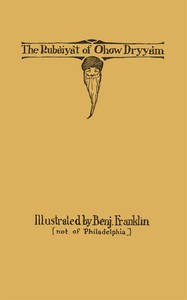
The catalog record for The Rubaiyat of Ohow Dryyam With Apologies to Omar — A Closer Reading provides practical reading context through 3,778 words, 17 min estimated reading time, and 1 detected text section.
The text analysis averages about 24.7 words per sentence, while the detected sections provide another way to judge how the source is divided.
Project Gutenberg metadata also associates the work with “Prohibition,” connecting these edition facts with the source record’s subject description.
Explore this collection
These alternatives are selected using recorded categories and estimated reading time.
About 26 minutes
Adventure Picaresque Fiction
5,814 recorded words. 9 minutes difference from this book's estimate.
View Gutenberg source #24018About 28 minutes
Adventure Picaresque Fiction
6,338 recorded words. 11 minutes difference from this book's estimate.
View Gutenberg source #28184About 47 minutes
Adventure Picaresque Fiction
10,652 recorded words. 30 minutes difference from this book's estimate.
View Gutenberg source #6136Search stored excerpts and compare books → Choose by your preferences →
Choices use stored catalog measurements. Estimates vary with reading speed. A shared category is a catalog label, not a claim that two books have the same argument or literary quality.
Search reads excerpt text stored with this catalog and links to its associated Gutenberg record. The connection is stored in the site database; this tool does not recheck that every excerpt is word-for-word identical to that external record. Excerpt search does not cover every chapter and does not verify historical publication dates.
Catalog snapshot checked: 2026-09-25. Coverage: 93 public books, 93 available source excerpts.
Read the complete public-domain text at its original source.
Read on Project GutenbergJ. L. Duff's The Rubaiyat of Ohow Dryyam (1922) is a sustained parody of Edward FitzGerald's translation of Omar Khayyám, repurposing the Persian quatrain form to mourn the loss of alcoholic drink under Prohibition. The poem opens with a wail: 'the Law has scattered into flight / Those Drinks that were our sometime dear Delight.' Duff retains the original's refrain structure—repeating key lines like 'The Bird of Time flies with a steadier wing / But roosts with sleepless Eye—a Coffee Souse!'—but replaces wine with coffee, tea, and moonshine. The setting shifts from a garden to a coffee-house, and the beloved's sigh is met with the retort: 'Wilderness? It’s Desert, Sister, now.'
Duff closely follows the Rubaiyat's aaba rhyme scheme and its use of repeated refrains. Quatrains II, V, and X each end with a line that recurs as a refrain: 'And still the Morals-tinkers plot and plan / New, sterner, stricter Statutes to indite'; 'The Bird of Time flies with a steadier wing / But roosts with sleepless Eye—a Coffee Souse!'; and 'The Scanty Stock we set our hearts upon...' These refrains create a rhythmic lament, echoing the original's meditation on transience but redirected toward the dwindling supply of alcohol. The repetition underscores the monotony of enforced sobriety, as the speaker cycles through variations on the same complaint.
The poem is built on a series of substitutions: wine becomes coffee, beer becomes tea, the tavern becomes the coffee-house. Quatrain III describes a 'deathly Pallor' on the nose that once 'bourgeoned with color of the rose,' a clear reference to the red nose of a drinker now gone pale. 'Johnny Walker—Water goes' replaces the whiskey brand with plain water. The 'Book of Blue Laws' replaces the 'Book of Verses' from the original, and the beloved's sigh is met with a sardonic correction. These substitutions are not merely comic; they convey a sense of deprivation and absurdity, as the speaker tries to find solace in 'a pot of Tea, a piece of Toast' while longing for 'the beer of Yesterday.'
The poem shifts between the coffee-house, the 'gilded Bar' of memory, and imagined escapes to 'Canada or Scotland or Algiers.' Quatrain IV invites the beloved to 'the Coffee-house' for a 'new and temperate Carouse,' while Quatrain VI places the speaker 'underneath the Bough' with tea and toast, only to dismiss the pastoral setting as a 'Desert.' The interior spaces—bars, coffee-houses, homes—are contrasted with the 'Wilderness' of a dry America. The speaker's mind moves restlessly from present deprivation to past indulgence and future flight, a pattern that mirrors the original's carpe diem urgency but with a distinctly modern, Prohibition-era anxiety.
The speaker adopts a tone of mock-heroic lament, addressing the beloved with the same apostrophes as the original but undercutting them with bathos. 'Ah, my Beloved, fill the Cup that clears / Today of past Regrets and future Fears' is immediately followed by 'Tomorrow!—Why, Tomorrow I may be / In Canada or Scotland or Algiers!' The 'Morals-tinkers' are the primary satirical target, along with 'Blue Laws' and the 'legal Finger' that writes and cannot be lured back. The poem also mocks the temperance movement's promises: 'Some for a Sunday without Taint, and Some / Sigh for Inebriate Paradise to come.' Duff's voice is consistently sardonic, never fully despairing, and the humor arises from the incongruity between the lofty Persian form and the mundane reality of Prohibition.
Readers familiar with FitzGerald's Rubaiyat will recognize the scaffolding Duff borrows, but the poem stands on its own as a period piece of Prohibition-era satire. The quatrains reward attention to how Duff twists the original's imagery—the 'Moving Finger' becomes a 'legal Finger,' the 'Bird of Time' becomes a 'Coffee Souse.' The poem is best read aloud to catch the rhythm of the refrains and the sly substitutions. It offers a snapshot of a specific cultural moment, when the Land of the Free was, as the speaker puts it, 'washed—and dried.'
Reading The Rubaiyat of Ohow Dryyam, I felt the ache of empty barstools, that odd, shared grief for watered-down spirits. It made me think of my father’s old copy of The Works of Rudyard Kipling: One Volume Edition — A Reader’s Guide, though the reasons slip away. Perhaps it’s the way both voices carry empire—one of lost taverns, the other of lost frontiers—and how softly those worlds fade.
Create a short personal record of your experience with this book.