About 273 minutes
English and Scottish Ballads, Volume II — Key Ideas to Explore
Science Fiction Utopias
62,728 recorded words. 58 minutes difference from this book's estimate.
View Gutenberg source #37738
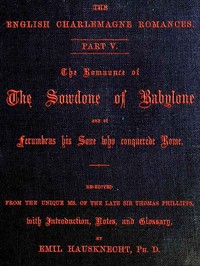
The Romaunce of the Sowdone of Babylone and of Ferumbras His Sone Who Conquerede Rome — A Closer Reading can be approached with a clearer sense of reading commitment from its source measurements: 75,919 words, 5 hr 31 min estimated reading time, and 27 detected text sections.
The text analysis averages about 13.4 words per sentence, while the detected sections provide another way to judge how the source is divided.
Project Gutenberg metadata also associates the work with “Romances, English,” connecting these edition facts with the source record’s subject description.
Explore this collection
These alternatives are selected using recorded categories and estimated reading time.
About 273 minutes
Science Fiction Utopias
62,728 recorded words. 58 minutes difference from this book's estimate.
View Gutenberg source #37738About 394 minutes
Science Fiction Utopias
90,550 recorded words. 63 minutes difference from this book's estimate.
View Gutenberg source #32373About 401 minutes
Science Fiction Utopias
92,134 recorded words. 70 minutes difference from this book's estimate.
View Gutenberg source #8683Search stored excerpts and compare books → Choose by your preferences →
Choices use stored catalog measurements. Estimates vary with reading speed. A shared category is a catalog label, not a claim that two books have the same argument or literary quality.
Search reads excerpt text stored with this catalog and links to its associated Gutenberg record. The connection is stored in the site database; this tool does not recheck that every excerpt is word-for-word identical to that external record. Excerpt search does not cover every chapter and does not verify historical publication dates.
Catalog snapshot checked: 2026-09-25. Coverage: 93 public books, 93 available source excerpts.
Read the complete public-domain text at its original source.
Read on Project GutenbergThe Middle English romance The Romaunce of the Sowdone of Babylone and of Ferumbras His Sone Who Conquerede Rome, re-edited by Emil Hausknecht, presents a narrative that oscillates between rapid, formulaic battle sequences and extended, dialogue-driven council scenes. The editor’s introduction situates the poem within the tradition of Charlemagne romances, noting its debt to earlier French sources. A striking feature is the poem’s use of direct speech to dramatize conflict, as seen in the Soudan’s council where advisors Sortibrance and Brouland propose sending twelve knights to Charles. The verse’s pace shifts markedly when characters speak, slowing to accommodate threats and pleas, then accelerating into action.
The excerpt from lines 1740–1780 reveals a deliberate change in pace. The Soudan’s complaint—“He brennyth my Toures and my Citees, / And Burges he levethe me never oo”—is delivered in a measured, lamenting tone, with each line end-stopped. But when Sortibrance responds, the verse quickens with imperative verbs: “Take xij knightis … and sende hem to Charles.” The rhythm becomes more urgent, mirroring the escalation of threat. The Soudan’s oath “by Mahounde” and his vow to hang Ferumbras “as hye, as any shippes maste” inject a visceral, almost physical speed into the stanza. This alternation between deliberation and outburst is a hallmark of the poem’s narrative technique.
In the earlier passage (lines 1692–1736), Charlemagne’s wrath is rendered through a repetitive structure: each baron who objects is ordered to go, with the king’s commands growing more terse. “Go thou forth in this same rees” and “Dresse the forth with he eke” create a staccato rhythm, while the barons’ pleas are longer and more varied. Bishop Turpin’s kneeling and plea—“lege lorde, mercy!”—contrasts with the king’s swift, almost mechanical response: “Thou goist eke, make the in hast redye!” The repetition of “go” and “shalte” across multiple stanzas builds tension, as the reader senses the inevitability of the mission. The narrator then abruptly shifts focus: “Owe let hem passe in goddis name, / And speke we of the Sowdo.” This direct address to the audience marks a clear break in pace, signaling a new scene.
Hausknecht’s introduction, written in formal Victorian prose, contrasts sharply with the poem’s colloquial Middle English. He describes Charlemagne as “the great and valiant champion of Christendom,” a phrase that echoes the romance’s own heroic register. Yet his scholarly apparatus—notes, glossary, and source comparisons—imposes a slower, analytical pace on the reader. The poem itself, with its frequent use of direct speech and formulaic lines like “Thay toke here lefe and forth thay yede,” moves quickly, often skipping over travel or time. Hausknecht’s footnotes, however, pause to explain dialect forms or historical references, creating a dual reading experience: the swift narrative of the romance and the deliberate commentary of the editor.
Readers attentive to shifts in pace will notice how the poem uses direct speech to control tempo, slowing for council debates and accelerating for threats or commands. The editor’s notes provide a counter-rhythm, inviting reflection on the poem’s sources and language. This edition rewards those who read both the verse and the apparatus, observing how a medieval romance can be both swift and deliberate.
Reading the editor’s notes on the Soudan’s council, I found myself pausing over how slowly those pressures mount, how choices harden into consequence. It felt familiar, that weight of obligation disguised as command. Later I thought of Spenser’s quieter moments, where similar forces drift through allegory like weather. I reached for The Faerie Queene — Volume 01 — A Reader’s Guide, and the afternoon softened around me, almost like remembering.
Save your reaction, strongest insight, and memorable passage.