About 189 minutes
Beowulf: An Anglo-Saxon Epic Poem — Key Ideas to Explore
Science Fiction Utopias
43,379 recorded words. 3 minutes difference from this book's estimate.
View Gutenberg source #16328
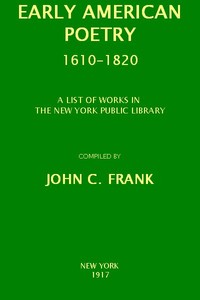
For Early American Poetry 1610-1820: A List of Works in the New York Public Library — Themes and Context, the stored edition analysis reports 44,149 words, 3 hr 12 min estimated reading time, and 7 detected text sections.
The text analysis averages about 7.9 words per sentence, while the detected sections provide another way to judge how the source is divided.
Project Gutenberg metadata also associates the work with “American poetry -- Colonial period, ca. 1600-1775 -- Bibliography,” connecting these edition facts with the source record’s subject description.
Explore this collection
These alternatives are selected using recorded categories and estimated reading time.
About 189 minutes
Science Fiction Utopias
43,379 recorded words. 3 minutes difference from this book's estimate.
View Gutenberg source #16328About 209 minutes
Science Fiction Utopias
48,047 recorded words. 17 minutes difference from this book's estimate.
View Gutenberg source #38438About 169 minutes
Science Fiction Utopias
38,641 recorded words. 23 minutes difference from this book's estimate.
View Gutenberg source #20431Search stored excerpts and compare books → Choose by your preferences →
Choices use stored catalog measurements. Estimates vary with reading speed. A shared category is a catalog label, not a claim that two books have the same argument or literary quality.
Search reads excerpt text stored with this catalog and links to its associated Gutenberg record. The connection is stored in the site database; this tool does not recheck that every excerpt is word-for-word identical to that external record. Excerpt search does not cover every chapter and does not verify historical publication dates.
Catalog snapshot checked: 2026-09-25. Coverage: 93 public books, 93 available source excerpts.
Read the complete public-domain text at its original source.
Read on Project GutenbergThis bibliography, compiled by John C. Frank and published in 1917, catalogs the early American poetry holdings of the New York Public Library as of August 1, 1917. It covers works from 1610 to 1820, drawing from the Reference Department at the Central Building. The list includes not only books but also broadsides, periodical contributions, and manuscript annotations, as seen in the entry for All the world’s a stage where a contemporary hand identifies the author as Isaac Story.
The compiler’s method is evident in the meticulous recording of editions, reprints, and reviews. For instance, John Blair Linn’s Valerian appears in multiple editions from Philadelphia and London, with a note on its frontispiece portrait silhouette. Such details reveal the library’s effort to document the material history of American verse.
The entries consistently record physical details: pagination, format (e.g., 16º, 4º), and location within the library (e.g., “Reserve,” “NBHD”). For John Adams’s Poems on several occasions, the imprint includes the bookseller’s address “over against the Old South Meeting House,” situating the volume in Boston’s geography. The compiler also notes when a name is written on a title page, as with “I. Storey” in All the world’s a stage, linking the anonymous work to a known author.
Cross-references to periodicals like The Monthly anthology and Boston review and The American museum show that many poems first appeared in magazines. The entry for William Livingston’s “A morning hymn” traces its reprinting across multiple anthologies from 1791 to 1829, demonstrating the compiler’s attention to textual transmission.
Several entries highlight poetry as political commentary. Henry Brockholst Livingston’s Democracy: an epic poem (1794) is described as written “in consequence of a tumultuous meeting” and includes extracts reprinted in The Echo with a note explaining why the second canto went unpublished. William Livingston’s “Burgoyne’s Proclamation” is labeled a “burlesque ballad” and traced to later collections of Revolutionary songs.
The bibliography also records pseudonymous works, such as Benjamin Allen’s Miscellaneous poems under the name “Osander,” and the anonymous The Squabble attributed to “Agricola.” These entries reflect the era’s use of satire and anonymity to navigate political tensions.
Judith Lomax’s The notes of an American lyre (1813) is listed with the note that she is “a native of the State of Virginia,” signaling regional identity. The bibliography includes other women, such as the anonymous author of A Little looking-glass for the times (attributed to “G. C.”). These entries are sparse but significant, as they document early female participation in American poetry.
The compiler also notes works from outside major cities: John Adams’s Boston imprint, Benjamin Allen’s Hudson publisher, and the Albany Register broadside. This geographic range underscores the spread of poetic production beyond the coastal centers.
Readers interested in the material culture of early American poetry will find this list a valuable index of editions, reprints, and library provenance. The annotations—such as the note on John Blair Linn’s portrait silhouette or the cross-references to contemporary reviews—offer starting points for deeper research into how these works were received and preserved. The bibliography’s focus on holdings as of 1917 also provides a snapshot of institutional collecting priorities at that time.
Years spent among shelves taught me that a bibliography, like the old New York Public Library list of early American verse, holds a strange warmth—each entry a small life waiting. I find that same gentle pulse in Yorkshire Ditties, First Series To Which Is Added The Cream Of Wit And Humour From His Popular Writings — Story, Setting & Ideas, where homely rhymes breathe quietly beside those colonial songs, both simply keeping company with their own times.
Build a private reading journal entry for this title.