About 170 minutes
The Posy Ring: A Book of Verse for Children — Key Ideas to Explore
Historical Psychological Social Fiction
38,991 recorded words. 4 minutes difference from this book's estimate.
View Gutenberg source #22922
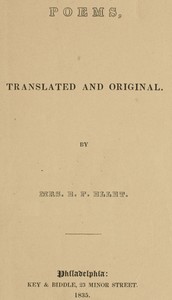
For Poems, translated and original — A Closer Reading, the stored edition analysis reports 37,958 words, 2 hr 46 min estimated reading time, and 80 detected text sections.
The text analysis averages about 15.7 words per sentence, while the detected sections provide another way to judge how the source is divided.
Project Gutenberg metadata also associates the work with “Venice (Italy) -- Drama,” connecting these edition facts with the source record’s subject description.
Explore this collection
These alternatives are selected using recorded categories and estimated reading time.
About 170 minutes
Historical Psychological Social Fiction
38,991 recorded words. 4 minutes difference from this book's estimate.
View Gutenberg source #22922About 159 minutes
Historical Psychological Social Fiction
36,442 recorded words. 7 minutes difference from this book's estimate.
View Gutenberg source #19About 179 minutes
Historical Psychological Social Fiction
41,074 recorded words. 13 minutes difference from this book's estimate.
View Gutenberg source #5131Search stored excerpts and compare books → Choose by your preferences →
Choices use stored catalog measurements. Estimates vary with reading speed. A shared category is a catalog label, not a claim that two books have the same argument or literary quality.
Search reads excerpt text stored with this catalog and links to its associated Gutenberg record. The connection is stored in the site database; this tool does not recheck that every excerpt is word-for-word identical to that external record. Excerpt search does not cover every chapter and does not verify historical publication dates.
Catalog snapshot checked: 2026-09-25. Coverage: 93 public books, 93 available source excerpts.
Read the complete public-domain text at its original source.
Read on Project GutenbergEllet's 1835 volume juxtaposes original compositions with translations from Italian poets such as Ugo Foscolo and Ippolito Pindemonte, as well as Norse-inspired pieces like 'Incantation of Hervor.' The collection's range is striking: a paraphrase of Psalm 137 sits beside a 'Scene from Alfieri's Tragedy of Saul,' while the closing tragedy, Teresa Contarini, adapts a well-known Venetian historical incident. The preface notes that the play was successfully staged, with the heroine performed by Miss Phillips.
Ellet's translations are not merely literal renderings but creative engagements. In 'The Sepulchres,' from Foscolo, she preserves the original's meditative tone while adjusting rhythm for English readers. The preface acknowledges borrowing from Niccolini's play on the same Venetian subject for 'a few occasional passages,' yet insists the plot and leading incidents 'differ materially.' This selective appropriation suggests a translator who adapts source material to her own dramatic purposes. The inclusion of Alfieri's Saul and Pindemonte's 'The Poet's Last Dwelling' further indicates a deliberate choice of Italian authors concerned with political exile, mortality, and the poet's role—themes that resonate across her original poems.
Several original poems dwell on American and European landscapes with a Romantic sensibility. 'Lake Ontario,' 'Susquehanna,' and 'Sodus Bay' evoke specific North American settings, while 'The Pictured Rocks' describes a natural formation on Lake Superior. In 'The Northern Hunter's Song,' the speaker summons a 'forest vast' and a 'rushing stream from his fetters free,' blending exhilaration with a hint of Ossianic wildness. The imagery of 'peaks of snow' vanishing beneath the sun and the 'eagle has flown from his cliff-built nest' aligns with the sublime tradition. These poems often personify nature—'the hoarse waves' mingled roar'—and treat the natural world as a stage for human emotion.
Death recurs as a theme across both translations and original works. In 'The Sepulchres,' Foscolo's lines ask whether sleep is 'less heavy' beneath a 'sculptured urn / By fond tears watered.' Pindemonte's 'The Poet's Last Dwelling' imagines a 'nameless stone' marking the poet's grave, with the hope that a friend might pause there. Ellet's own 'Death' and 'The Dying Poet' treat the subject more directly. The closing tragedy, Teresa Contarini, presumably dramatizes a fatal conflict from Venetian history. Throughout, the collection suggests that memory—whether preserved in poetry, tears, or stone—offers a partial victory over oblivion.
Readers approaching this volume may find it useful to read the original poems alongside the translations, noting how Ellet's voice shifts between registers. The tragedy at the end, though based on historical incident, should be considered as a dramatic work rather than a historical document. The index provides a clear map of the collection's contents, allowing for selective reading by theme or source.
I remember this 1835 volume—its Venetian shadows and Ossianic mists taught me how solitude shapes a voice. Years later, when I found Poems by Isaac Rosenberg — Text and Context, I felt that same quiet kinship: two poets speaking from the edge of things, each holding a lantern low, content to let the dark keep its secrets.
Build a private reading journal entry for this title.