About 488 minutes
King Horn, Floriz and Blauncheflur, The Assumption of Our Lady — Story, Setting & Ideas
Historical Psychological Social Fiction
112,215 recorded words. 94 minutes difference from this book's estimate.
View Gutenberg source #42713
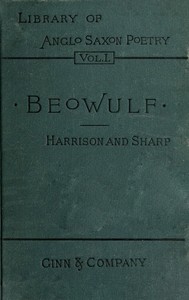
This digital edition of I. Beówulf: an Anglo-Saxon poem. II. The fight at Finnsburh: a fragment. — A Reader’s Guide is described by source-level measurements including 133,687 words, 9 hr 42 min estimated reading time, and 41 detected text sections.
The text analysis averages about 8.3 words per sentence, while the detected sections provide another way to judge how the source is divided.
Project Gutenberg metadata also associates the work with “Epic poetry, English (Old),” connecting these edition facts with the source record’s subject description.
Explore this collection
These alternatives are selected using recorded categories and estimated reading time.
About 488 minutes
Historical Psychological Social Fiction
112,215 recorded words. 94 minutes difference from this book's estimate.
View Gutenberg source #42713About 367 minutes
Historical Psychological Social Fiction
84,322 recorded words. 215 minutes difference from this book's estimate.
View Gutenberg source #39627About 343 minutes
Historical Psychological Social Fiction
78,687 recorded words. 239 minutes difference from this book's estimate.
View Gutenberg source #19221Search stored excerpts and compare books → Choose by your preferences →
Choices use stored catalog measurements. Estimates vary with reading speed. A shared category is a catalog label, not a claim that two books have the same argument or literary quality.
Search reads excerpt text stored with this catalog and links to its associated Gutenberg record. The connection is stored in the site database; this tool does not recheck that every excerpt is word-for-word identical to that external record. Excerpt search does not cover every chapter and does not verify historical publication dates.
Catalog snapshot checked: 2026-09-25. Coverage: 93 public books, 93 available source excerpts.
Read the complete public-domain text at its original source.
Read on Project GutenbergThe Harrison and Sharp edition of Beowulf presents the poem in forty-three numbered sections, each a discrete narrative unit. The editors' decision to include the Finnsburh fragment as a companion piece underscores the importance of battle scenes and hall-life in the Anglo-Saxon imagination. The glossary entries reveal a poet attentive to the physical world: words for sea (flôd), earth (folde), and flight (flyht) recur with notable frequency, linking the poem's action to elemental forces.
The poem's structure is tripartite, moving from Heorot to the mere and finally to the dragon's barrow. Each location carries distinct imagery: Heorot is a fäger fold-bold (fair earth-house), a place of light and community; the mere is a flôda begong (region of floods), dark and inhabited by monstrous kin; the barrow is a foldan bearm (bosom of the earth), a burial mound that becomes a tomb. The hero's journey traces a descent from hall to water to earth, each stage marked by a confrontation with a creature that embodies the threat of that realm.
The sea is a constant presence, described through compounds like flôd-ýð (flood-wave) and wæg-flota (wave-floater). The hero's swimming contest with Breca is recalled in the glossary entry for flîtan (to strive), where Beowulf is said to have ymb sund flite (contended about swimming). The sea is both a path and a barrier: the Geats cross it to reach the Danes, and the mere is a stagnant inland water. The poem's vocabulary emphasizes motion across water, with verbs like flîtan and ofer-flîtan (to surpass) linking physical exertion to competitive striving.
Heorot is the poem's central setting, a folcstede (place of warriors) where the community gathers. The hall's floor is fâgne flôr (variegated floor), possibly a mosaic, suggesting artistry and wealth. Yet it is also the site of Grendel's attacks, a space where the boundary between inside and outside is violated. The glossary entries for flôr and fold-bold emphasize the hall's materiality, while the repeated use of folc-cyning (king of the host) and folces hyrde (shepherd of the people) ties the hall to kingship and social order.
The final movement shifts to the dragon's barrow, described as a foldan fäðm (embrace of the earth). The glossary shows folde used for both ground and world, linking the barrow to the cosmic earth. The dragon is a wîd-floga (wide-flier), a creature of air and fire, but its hoard lies in the earth. The poem's vocabulary of burial—foldan bearm (bosom of the earth)—anticipates Beowulf's own mound. The hero's death returns him to the earth from which the poem's imagery never fully departs.
Readers attentive to the poem's structure will notice how each movement repeats a pattern of arrival, confrontation, and departure, with the landscape shifting from hall to mere to barrow. The Harrison and Sharp edition, with its detailed glossary and notes, invites scrutiny of the poet's word choices, revealing a world where the sea, the hall, and the earth are not just settings but active participants in the narrative.
That gray afternoon, the rain blurred the windows while I traced Beowulf’s descent from bright hall to cold mere, and later, to that dragon’s barrow. The weight of earth felt almost tangible. Closing the guide, I lingered on the airlessness. Later, idly, I picked up Spirits in Bondage: A Cycle of Lyrics — A Closer Reading, and found the same closed-in struggle, but voiced from within the silence.
Build a private reading journal entry for this title.