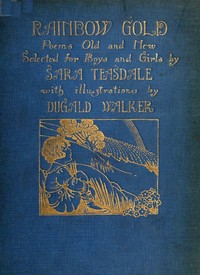
Sara Teasdale's prefatory note to Rainbow Gold lays out a deliberate, personal method: she chose poems that would have pleased her childhood self and her playmate, guided by their enjoyment or boredom. The result is a compact collection that prioritizes "highly accented rhythms" and "a land of clear colors and stories" over meditative or moralistic verse. Teasdale explicitly excludes gloomy or sentimental poems, noting they were never read but once. This editorial stance shapes the anthology's voice—lively, rhythmic, and image-driven—as seen in selections like Shakespeare's winter song with its "greasy Joan" and Dobell's "Chanted Calendar" with its personified flowers.
Rhythm as a Guiding Principle
Teasdale's preface reveals that the poems her childhood self loved best had "highly accented rhythms." This criterion is evident in the excerpts: Shakespeare's "When icicles hang by the wall" uses a steady trochaic beat, while Dobell's "A Chanted Calendar" employs anapestic and dactylic variations to mimic the flowers' movements. The compiler's emphasis on rhythm over theme or moral lesson distinguishes this anthology from many contemporary collections for children, which often leaned toward didacticism. Teasdale's approach privileges the physical pleasure of sound—the "merry note" of the owl, the "dance and tabor" of the daisies—over instruction.
Clear Colors and Stories
Teasdale writes that the poems she loved took her into "a land of clear colors and stories." The excerpts bear this out: Dobell's primrose is "like a maiden looking forth / From the window of a tower," and the daisies arrive "like a bannered show's advance." Even Shelley's "The Cloud" paints vivid scenes—the "sanguine Sunrise with his meteor eyes" and the moon as "that orbèd maiden with white fire laden." The imagery is concrete and narrative, often personifying natural elements into characters with actions and emotions. This preference for visual storytelling over abstract reflection shapes the anthology's tone, making it accessible and engaging for young readers.
A Mix of Old and New Voices
Teasdale's selection spans from Elizabethan lyrics (Shakespeare) to contemporary poets like Sydney Dobell and Percy Bysshe Shelley. The preface notes she would have liked to make separate volumes for different eras, but the small size forced a curated mix. The excerpts show a range of voices: Shakespeare's colloquial, scene-setting verse; Dobell's elaborate, simile-laden narrative; Shelley's grand, mythic personification. This variety introduces young readers to different poetic periods and styles within a single, compact book. Teasdale's editorial hand ensures that despite the range, all poems share a focus on rhythm and vivid imagery, creating a cohesive yet diverse reading experience.
Teasdale's anthology invites readers to approach poetry as a sensory experience first—listening for the beat, watching for the image. The preface's honesty about her method—choosing poems that would have pleased a specific child—offers a lens for reading: these are poems meant to be enjoyed, not analyzed. Readers might notice how the rhythm changes from poem to poem, or how each poet paints a scene differently. The book rewards attention to sound and sight, not moral or thematic interpretation.
I keep coming back to those old songs in Rainbow Gold, the way Teasdale trusted rhythm to carry feeling without explaining it. There’s something quiet and unfinished in that trust. Reading Three Unpublished Poems — Themes and Context felt like finding a note slipped between pages—her voice still half-turned away, not asking to be understood, just glad to be heard.