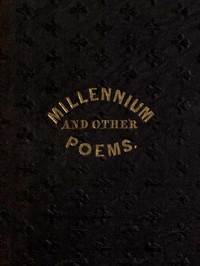
Parley P. Pratt's The Millennium, and Other Poems (1840) is a volume shaped by its circumstances: some poems were composed on the bank of Niagara, others in a Missouri dungeon where Pratt was confined for eight months during the Mormon persecution. The preface describes the work as a compilation of pieces that "sprang into existence one after another as occasion called them forth," ranging from joyful anticipation of a millennial dawn to grief-stricken laments for lost loved ones. The appended treatise, "The Regeneration and Eternal Duration of Matter," was written in prison and offered the author comfort "when death stared me in the face."
A Poetic Geography of Exile and Ascent
The poems are anchored to specific landscapes that mirror Pratt's spiritual and physical journey. The preface catalogs sites of composition: the White Mountains of New Hampshire, the "flowery plains and wide-extended prairies of the west," crowded halls, and lonely forests. One excerpt describes a climb up Mount Lafayette, where the party passes through zones of vegetation—dwarf cedars, then bare rock—to a summit lake fed by melting snow. The view from the top is rendered in rhyming couplets: farms, fields, lakes, and "the briny ocean's distant blue." But the scene is abruptly veiled by clouds, and the climbers descend into summer warmth. This pattern of elevation and obscurity, of physical exertion yielding to spiritual reflection, recurs throughout the collection, tying doctrinal hope to tangible geography.
Prison as a Site of Philosophical Production
The treatise "The Regeneration and Eternal Duration of Matter" is explicitly a prison composition, written to console the author and his companions. Pratt opens by asserting that "Matter and Spirit are the two great principles of all existence," both eternal and self-existent. He frames this not as speculative philosophy but as a subject "of deep and thrilling interest to all the human family," equally relevant to Jew, Christian, Muslim, and pagan. The argument is grounded in a scriptural epigraph from Revelation: "Behold, I make all things new." The prison setting lends urgency to the discussion of death and resurrection; Pratt writes from a place where "death stared me in the face," yet the treatise is not merely personal—it aims to address universal anxiety about the afterlife. The juxtaposition of confinement and cosmic scope is a defining tension of the volume.
Contrasts in Voice and Form
The collection moves between poetic and prose forms, public and private registers. The poems include hymns, farewells, laments, and patriotic pieces—titles such as "True Patriotism," "Farewell," and "Lamentation" suggest a range of occasions. The preface notes that some poems were "wrung from a bosom overflowing with grief" at personal loss, while others celebrated the approaching millennium. The prose treatise, by contrast, adopts a systematic, argumentative tone, though it too is punctuated by emotional appeals. Pratt's voice shifts from the descriptive couplets of the mountain climb to the doctrinal exposition of matter's eternity. This formal variety reflects the author's dual role as minister and prisoner, public figure and private sufferer, and gives the volume a fragmented, documentary quality—a record of faith tested by persecution.
Readers approaching this volume should attend to the interplay between its parts: the poems and the treatise are not separate works but complementary responses to the same crisis. The preface's account of the poems' origins—in dungeons, on mountaintops, at farewells—provides a key to their emotional logic. Pratt's theological claims about matter's indestructibility gain force when read alongside the laments for lost loved ones and the hymns of millennial hope. The book is best understood as a document of survival, shaped by the specific pressures of Pratt's imprisonment and his Latter-day Saint convictions.
That rainy afternoon, Pratt’s insistence on matter’s eternal weight felt like a hand on my shoulder—everything lasts, even grief. Later, pulling a random shelf, I found Rainbow gold; poems old and new selected for boys and girls — Themes and Context, its childish wonder a gentler echo of the same stubborn hope. Some books just sit beside each other, quietly.