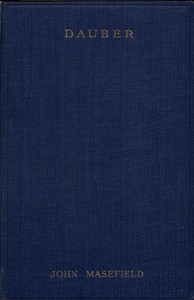
John Masefield's Dauber: A Poem opens not with a storm or a departure but with the mundane rhythm of shipboard routine: "Four bells were struck, the watch was called on deck." The catalog subjects list seafaring life, sailors, art, and artists, but the poem's early stanzas immediately complicate those categories. The title character is introduced as "the painter in that swift ship's crew—Lampman and painter—tall, a slight-built man," a figure isolated by his vocation. His shipmates "called him 'Dauber' and despised him," and the poem's voice shifts between the crew's coarse dismissal and the Dauber's own earnest, almost naive aspirations. The excerpts show that the poem is less a celebration of maritime art than a study of how artistic sensibility collides with a working environment that values physical competence above all else.
The Dauber's Double Identity
The catalog subjects list "Artists -- Poetry" and "Sailors -- Poetry" as separate categories, but the poem intertwines them in a single character. The Dauber is both a working hand—mixing red lead in bouilli tins, smeared with paraffin—and a visionary who dreams of painting "great ships at sea before I'm dead." His shipmates see only his ineptitude: "Being neither man nor seaman by his tally." Yet the poem gives him long, articulate speeches about his craft, as when he tells Si, "I want to be a painter... And know the sea and ships from A to Z." This duality is not resolved; the Dauber remains an outsider, bunking "with the idlers just abaft the galley." The poem's structure reinforces this split by alternating between the crew's mocking dialogue and the Dauber's interior reflections, creating a tension that the catalog's neat subject headings cannot capture.
The Storm as Technical Challenge
The poem's most extended passage, a violent storm, might seem to belong to the "Seafaring life -- Poetry" subject, but Masefield renders it as a problem of perception and craft. The Dauber experiences the gale not just as physical terror but as a test of his ability to observe: "He saw the water darken... The sky went out, the waters disappeared." The language is precise about nautical details—"the yards buckled and bent," "the backstays parted with a cracking clang"—yet the focus remains on what the Dauber sees and feels. When the bosun yells "Cut!" and the mate slashes canvas, the Dauber's response is a moaned "O God!" The storm is not a generic adventure but a specific, sensory ordeal that the poem insists on rendering from the inside, matching the Dauber's stated goal: "It's not been done, the sea, not yet been done, / From the inside, by one who really knows."
Voice and the Limits of Evidence
The excerpts provide only the poem's opening and a later storm sequence, leaving the Dauber's fate and the poem's overall arc uncertain. What is clear is the poem's distinctive voice: a third-person narrator who slips into the Dauber's perspective but also reports the crew's slang and mockery. The catalog subject "Psychological & Social Fiction" is apt, but the poem is not a novel; its compressed, rhyming stanzas (ababbcb) impose a formal discipline that shapes the psychological content. The Dauber's dialogue with Si reveals his artistic philosophy, but the excerpts do not show whether he ever paints his great ship. Readers should attend to how Masefield uses meter and rhyme to heighten moments of crisis—the storm's "clang, clang, clang, below beat the two bells"—and how the Dauber's voice competes with the collective voice of the crew. The poem's title, Dauber, is itself a judgment from the crew, and the excerpts leave open whether the poem endorses or subverts that label.
Readers approaching Dauber should set aside expectations of a conventional sea adventure or a straightforward artist's biography. The poem is a sustained, often uncomfortable examination of what it means to pursue an art that demands direct experience of a brutal world. Masefield's language is concrete and unromantic, even when the Dauber speaks of beauty. Pay attention to the poem's shifts in register—from the crew's curses to the Dauber's measured explanations—and to the way the storm sequence forces the Dauber's aesthetic ambitions into a physical reality that cannot be controlled or framed. The catalog subjects offer a starting point, but the poem itself resists easy categorization.
I remembered standing on a ferry deck once, watching the water’s endless gray, and feeling how small a person’s ambition can be against that vastness. Masefield’s painter seemed so close to me then. Later, I found that same quiet ache of longing in The Earthly Paradise: A Poem (Part II) — Reading Notes, the way beauty always waits just beyond the ordinary hours. Both left me staring out a window, not quite ready to turn back.