About 109 minutes
A Book of Strife in the Form of The Diary of an Old Soul — Inside the Classic
Historical Psychological Social Fiction
24,984 recorded words. 11 minutes difference from this book's estimate.
View Gutenberg source #1953
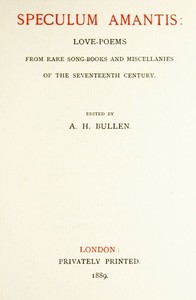
This digital edition of Speculum Amantis Love Poems, from Rare Songbooks and Miscellanies of the Seventeenth Century — Reading Notes is described by source-level measurements including 22,319 words, 1 hr 38 min estimated reading time, and 5 detected text sections.
The text analysis averages about 19.2 words per sentence, while the detected sections provide another way to judge how the source is divided.
Project Gutenberg metadata also associates the work with “English poetry -- Early modern, 1500-1700,” connecting these edition facts with the source record’s subject description.
Explore this collection
These alternatives are selected using recorded categories and estimated reading time.
About 109 minutes
Historical Psychological Social Fiction
24,984 recorded words. 11 minutes difference from this book's estimate.
View Gutenberg source #1953About 87 minutes
Historical Psychological Social Fiction
19,972 recorded words. 11 minutes difference from this book's estimate.
View Gutenberg source #56607About 118 minutes
Historical Psychological Social Fiction
27,099 recorded words. 20 minutes difference from this book's estimate.
View Gutenberg source #66889Search stored excerpts and compare books → Choose by your preferences →
Choices use stored catalog measurements. Estimates vary with reading speed. A shared category is a catalog label, not a claim that two books have the same argument or literary quality.
Search reads excerpt text stored with this catalog and links to its associated Gutenberg record. The connection is stored in the site database; this tool does not recheck that every excerpt is word-for-word identical to that external record. Excerpt search does not cover every chapter and does not verify historical publication dates.
Catalog snapshot checked: 2026-09-25. Coverage: 93 public books, 93 available source excerpts.
Read the complete public-domain text at its original source.
Read on Project GutenbergThe volume opens with a Greek epigram warning that the rose's season is brief, then immediately sets a defiant tone in its prefatory poem 'Warning and Welcome,' which banishes the 'grave moralist' and invites those with 'brisker veins' to Cupid's feast. This framing establishes a central tension: the anthology self-consciously positions itself as a collection of verses that would not have been welcome on a Victorian drawing-room table, yet were once dedicated to noblewomen without scandal.
Bullen's preface explains that his earlier Elizabethan lyric collections were 'addressed to all classes of readers' and could 'lie on a drawing-room table without offence.' The present volume, by contrast, gathers songs that 'could find no place' in those decorous collections. He notes that John Attey's audacious verses 'My days, my months, my years' were dedicated to a countess in 1622, yet would now be considered shocking. This historical note frames the anthology as a deliberate recovery of poems that test the boundaries of propriety, offering readers a glimpse of a less restrained era.
The rose appears as a symbol of fleeting beauty from the opening epigram onward. In 'A Poem of Sir Walter Rawleigh's,' Nature creates a mistress from 'snow and silk,' but Time, 'made of steel and rust,' turns these to dust. The poem ends with the grave 'shutting up the story of our days.' Similarly, the anonymous 'Nobody's Song' dwells on mortality: 'When we are in grave, / Altho' we rave, / There is nobody needs to bind us.' These poems juxtapose sensual pleasure with an acute awareness of decay, a pattern that recurs throughout the collection.
The anthology shifts between courtly and pastoral settings. 'Cupid's Holiday' addresses 'Ladies, whose marble hearts despise / Love's soft impressions' in a formal, almost theatrical tone. In contrast, 'In summer-time, when birds do sing' presents a rustic scene of haymaking, where 'country maids' are led from their work to 'tumble up and down the green meadow.' This movement between refined and earthy registers mirrors the anthology's own straddling of decorum and license, with each poem offering a different social backdrop for love's pursuits.
Many poems employ a direct, confrontational address. 'Warning and Welcome' commands the 'grave moralist' to 'pack hence! away!' and the 'coy maiden' to stay away until marriage. 'Cupid's Holiday' tells virgins to 'hence; away!' and 'go, glory in the empty name / Of virgin.' This imperative mode creates a sense of immediacy and exclusion, as if the reader is being sorted into those who belong at the feast and those who do not. The poems often speak to a 'you'—whether a lover, a critic, or a lady—making the reader a participant in the debate over love's propriety.
The anthology's arrangement rewards reading across poems rather than in isolation. Notice how the same images—roses, time, the grave—reappear in different keys, from playful to somber. Bullen's editorial choices, especially his inclusion of poems from manuscript sources alongside printed miscellanies, highlight the fluid boundaries between public and private verse in the seventeenth century. Readers interested in the evolution of poetic decorum will find this collection a revealing counterpoint to more sanitized anthologies.
I found myself thinking of a summer afternoon years ago, pressing flowers between pages, when I read these seventeenth-century verses about roses and the grave. The same quiet ache returned with Spirits in Bondage: A Cycle of Lyrics — A Closer Reading, where beauty feels equally fragile, equally doomed, yet somehow more tender for its fleetingness.
Save your reaction, strongest insight, and memorable passage.