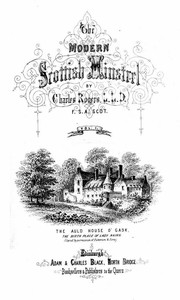
Charles Rogers's six-volume anthology, The Modern Scottish Minstrel, presents itself as a comprehensive record of Scottish song from the early 1800s to the mid-century. Yet the editor's hand is never far from view: each poet receives a biographical memoir, and the arrangement of verses often mirrors a narrative of cultural loss. The excerpts reveal a collection deeply concerned with memory, place, and the passage of time—themes that emerge not only in the poems but in the very structure of the work.
Biographical Framing as Editorial Strategy
Rogers does not simply present poems; he prefaces each author with a prose life. The memoir of John Gibson Lockhart, for instance, traces his lineage to Sir Stephen Lockhart of Cleghorn and notes his education at Glasgow and Oxford. This genealogical detail is typical: Rogers anchors poetic authority in social standing and classical learning. The biographies often emphasize early promise—Lockhart's prize for a translation of Lucan's Pharsalia—and later professional achievements, such as his editorship of the Quarterly Review. By foregrounding these credentials, Rogers positions the anthology as a record of respectable, often establishment, literary culture. The effect is to frame the songs not as folk expressions but as the work of educated individuals, many of whom moved in elite circles.
Diction and the Scots-English Spectrum
The poems in this collection occupy a wide range of linguistic registers. Some, like John Skinner's 'Tullochgorum,' use dense Scots: 'The ewie wi' the crookit horn' and 'Lizzy Liberty' show a vernacular that is both playful and precise. Others, such as Joanna Baillie's 'The gowan glitters on the sward,' mix Scots nouns ('gowan,' 'sward') with standard English syntax. A third group, including Mrs John Hunter's 'The Indian death-song,' employs entirely English diction. This variation is not random; it reflects the poets' different backgrounds and audiences. Rogers, by including all these styles, implicitly argues that Scottish song encompasses both the rural dialect tradition and the more polished verse of the drawing room. The reader moves from 'Cauld kail in Aberdeen' to 'The flowers of the forest' without editorial comment, allowing the contrasts to speak for themselves.
Recurring Motifs: Exile, Loss, and the Passing of Youth
Several poems share a preoccupation with departure and regret. In 'The ewie wi' the crookit horn,' the speaker laments being 'left alane' after children scatter and a spouse dies, concluding 'I 'm gaun to lay my puir auld clay / Within a foreign soil.' Similarly, 'O'er mountain and valley' uses a storm as an emblem of life's 'sunshine and gloom,' and warns that 'our own hands oft mingle / The bitters we drink.' These lines, drawn from different poets, echo each other in their focus on personal responsibility for sorrow and the inevitability of change. The anthology thus accumulates a collective voice of melancholy, even when individual poems vary in tone. Rogers's selection seems to favour verses that dwell on what is lost—youth, home, love—rather than what is gained.
The Editor's Role in Shaping a National Songbook
Rogers's title promises 'The Songs of Scotland of the Past Half Century,' but the contents reveal a deliberate narrowing. The memoirs and headnotes emphasize authors who are either Lowland Scots or Gaelic bards presented in translation. The inclusion of Gaelic poetry, rendered into English verse, suggests an attempt to unify Scotland's linguistic traditions under a single literary banner. Yet the translations are not glossed; the original Gaelic is absent. This editorial choice prioritizes accessibility over authenticity. Moreover, the biographical sketches often highlight the poets' connections to Edinburgh or Glasgow, reinforcing a central-belt perspective. A reader attentive to these patterns will notice that the anthology constructs a particular national narrative—one that is literate, urban-adjacent, and elegiac—rather than representing the full diversity of Scottish song in the period.
Approaching The Modern Scottish Minstrel as a curated collection rather than a neutral archive allows the reader to observe how Charles Rogers shaped nineteenth-century Scottish literary identity. The juxtaposition of memoir and verse, the range of dialects, and the recurring themes of exile and loss all reward careful attention. Readers interested in the politics of anthologizing will find much to explore in the gaps between the editor's claims and the poems' own emphases.
Closing Rogers’s volumes, I thought of my grandfather’s cracked copy of Scottish songs, the same ache of distance. Then I recalled Spirits in Bondage: A Cycle of Lyrics — A Closer Reading, where exile feels less sentimental, more raw—both books held that quiet longing for a home that no longer waits anywhere.