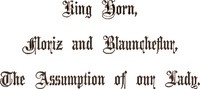
The volume collects three distinct Middle English works, each with its own manuscript tradition and editorial history. The first, King Horn, is presented in parallel columns from the Cambridge, Laud, and Harleian manuscripts, allowing direct comparison of textual variants. The second, Floriz and Blauncheflur, draws on the Trentham and Cotton manuscripts, while the third, The Assumption of Our Lady, appears from a single manuscript. The editorial notes, originally compiled by J. Rawson Lumby in 1866 and revised by George H. McKnight in 1901, focus on linguistic forms, metrical patterns, and parallels with other Middle English romances.
Manuscript Evidence and Textual Variation
The edition’s treatment of King Horn foregrounds the instability of medieval texts. Three manuscript versions—Cambridge Gg. 4.27.2, Laud Misc. 108, and Harleian 22—are printed side by side, revealing differences in dialect, spelling, and phrasing. For instance, line 861 reads “site stille” in the Cambridge text, while the Harleian version offers “ros of bedde” at line 895. The footnotes frequently cite parallels to other romances such as Havelok and Layamon’s Brut, suggesting a shared formulaic tradition. The editors also note scribal errors, such as “bidere” for “bitere” at line 1034, and trace the influence of French orthography, as in “enimis” (line 1024) retaining an Old French nominative singular -s. This apparatus makes visible the processes of copying and adaptation that shaped the surviving texts.
Lexical and Metrical Observations
The glossary and notes document the range of Middle English vocabulary across the three poems. Words like “wone” (custom), “wreie” (accuse), and “wyȝte” (brave) appear with variant spellings and cognates. The editors highlight rare forms, such as “lofte” meaning women’s apartments, which they suggest is of Norse origin. Metrical patterns are also examined: common rimes like “mette : grette” (line 1103-4) and “sonde : londe” (line 1077-8) recur across multiple texts, indicating conventional pairings. The notes occasionally question the consistency of the narrative, as when line 909 places a combat “on a grene” despite the earlier setting “at Cristesmasse” (line 853). Such observations point to the composite nature of the romance tradition.
The Assumption of Our Lady: A Religious Legend in Context
The third text, The Assumption of Our Lady, differs markedly from the preceding romances in subject and style. Cataloged under “Mary, Blessed Virgin, Saint – Legends,” it is a religious narrative rather than a secular adventure. The edition provides only one manuscript source, with fewer variant readings than King Horn. The glossary includes terms like “wreke” (avenge) and “wunian” (dwell), which appear in both religious and secular contexts. The editorial introduction (not included in the excerpts) presumably discusses the poem’s place in the Marian legend tradition. The juxtaposition of this pious work with the courtly tales of Horn and Floriz illustrates the range of Middle English literary production, from chivalric romance to hagiography, all treated with the same philological rigor.
Readers approaching this edition should be prepared for a scholarly apparatus that prioritizes linguistic detail over narrative summary. The parallel-text format of King Horn rewards careful comparison, while the notes offer a window into the editorial decisions that shaped the printed text. Those interested in the poems as literature may wish to read the continuous texts first, then consult the apparatus for specific lines. The volume stands as a record of late nineteenth-century philological practice, preserving multiple manuscript witnesses for further study.
Leafing through the old Middle English verses of King Horn, I felt a familiar ache—the simplicity of a song carried across centuries. It made me think of a certain volume of Scottish airs, each melody a similar keepsake of voices. I found myself turning to The Modern Scottish Minstrel, Volumes 1-6. The Songs of Scotland of the Past Half Century — Inside the Classic, just to hear that same quiet echo of another time. Both hold the past gently, without needing to demand much from the reader.